Most growing kids and teens need roughly 0.8 to 1.2 grams of protein per kilogram of body weight per day to support normal growth, though active adolescents benefit from hitting the higher end of that range. Protein is genuinely necessary for height growth because your body uses it to build bone matrix, cartilage, and muscle tissue. But it can't push you past your genetic ceiling. If you're already meeting your protein target, eating more won't add centimeters. And for adults whose growth plates have closed, no amount of protein changes your height.
How Much Protein Do You Need to Grow Taller

Marcus Reeves
31 May 2026

What protein actually does for growing taller (and what it doesn't)

Protein is the structural material your body uses to build almost everything involved in height: collagen in bone, cartilage at the growth plates, and the muscle tissue supporting your frame. When you eat protein, it gets broken down into amino acids that your body reassembles into these tissues. Growth hormone stimulates the liver to produce IGF-1 (insulin-like growth factor 1), and IGF-1 drives cell division at the epiphyseal growth plates, which is the actual mechanism that makes bones longer. Protein directly feeds that process. Without enough of it, growth is blunted even if everything else is in place.
That said, the hype around protein and height goes too far in a lot of corners of the internet. Protein doesn't directly stimulate growth hormone. It doesn't override genetics. Children who are protein-deficient can have stunted growth, and correcting that deficiency helps them catch up. But a child who is already meeting their protein needs won't grow taller by consuming more. The research is consistent on this: protein adequacy supports normal growth, but protein excess does not accelerate it.
Is protein alone enough to make you taller?
No, and that's worth being direct about. Protein is one necessary input in a system with multiple dependencies. You also need sufficient total calories, because if you're in a significant calorie deficit, your body will use dietary protein for energy rather than tissue building. Calcium and vitamin D support bone mineralization. Sleep is when growth hormone is primarily secreted. Genetics set the upper boundary of how tall you can grow. If any of these factors are severely lacking, protein adequacy alone won't compensate.
Think of it like building a house. Protein is the lumber, but you also need a foundation (calories), the right hardware (micronutrients), a crew that works at night (sleep and hormones), and a blueprint that sets the dimensions (genetics). If you are not eating enough calories, your body may have less energy to support growth, so adequate calories matter alongside protein calories to grow taller. Loading the job site with extra lumber when everything else is missing doesn't speed construction. The practical takeaway is that protein matters most when intake is genuinely too low. Once you're hitting your target, the return on additional protein for height diminishes to essentially zero.
How much protein to aim for at different ages

Protein needs aren't static. They scale with body weight, growth rate, and activity level. Here's a practical breakdown by life stage:
| Age Group | Recommended Range (g/kg/day) | Notes |
|---|---|---|
| Children (4-8 years) | 0.95 g/kg | Higher relative needs due to rapid growth phase |
| Children (9-13 years) | 0.95 g/kg | Same per-kg rate but total grams increase with body weight |
| Teens (14-18 years) | 0.85-1.0 g/kg | Growth spurts may push needs toward 1.0+ g/kg; active teens higher |
| Adults (19+) | 0.83 g/kg (EFSA PRI) | Adequate for non-growing adults; growth plates are closed |
| Active/Athletic Teens | 1.0-1.5 g/kg | Resistance training or intense sport adds to baseline needs |
The EFSA Population Reference Intake (PRI) for adults sits at 0.83 g/kg per day, which is calibrated to cover around 97.5% of healthy adults. For growing children and teens, the needs are slightly higher per kilogram because new tissue is being built continuously. Active teenagers doing regular sport or strength training are best served by the upper end of their range since muscle protein synthesis adds to the baseline demand.
How to calculate your actual protein target
The math is simple. Take your body weight in kilograms, then multiply by the appropriate rate for your age and activity level. If you only know your weight in pounds, divide by 2.2 first to get kilograms.
- Convert your weight: weight in pounds divided by 2.2 equals weight in kilograms
- Pick your multiplier based on age and activity (see table above)
- Multiply body weight (kg) by your multiplier to get your daily gram target
Example 1: A 13-year-old who weighs 45 kg (about 99 lbs). Using 0.95 g/kg: 45 x 0.95 = 42.75 grams per day. Round up to 43 grams as a practical minimum.
Example 2: A 16-year-old active male who weighs 65 kg (about 143 lbs) and plays basketball three times a week. Using 1.2 g/kg: 65 x 1.2 = 78 grams per day. That's a realistic and achievable target from food alone.
Example 3: A 22-year-old adult who weighs 70 kg (about 154 lbs). Using EFSA's PRI of 0.83 g/kg: 70 x 0.83 = 58.1 grams per day. This covers baseline needs, though growth plate closure means protein won't affect height at this point.
Getting your protein from food (with simple meal ideas)
Whole food sources are the best starting point. They come packaged with other nutrients (zinc, calcium, iron, B vitamins) that also support growth, and they're more satiating than supplements. Protein powders can fill gaps when food access is limited, but they're not necessary for most kids and teens eating a reasonably varied diet.
- Eggs: about 6 g of protein per egg, affordable, and extremely versatile
- Greek yogurt: 15-20 g per cup depending on brand, also a good calcium source
- Chicken breast: around 31 g per 100 g cooked, easy to meal prep
- Canned tuna or salmon: 20-25 g per serving, low cost and no cooking required
- Lentils and beans: 15-18 g per cooked cup, great for plant-based eaters paired with rice or grain
- Milk: 8 g per cup plus calcium and vitamin D, useful for younger kids
- Cottage cheese: 25 g per cup, easy snack with fruit
- Tofu (firm): about 17 g per half-cup, good for plant-based diets
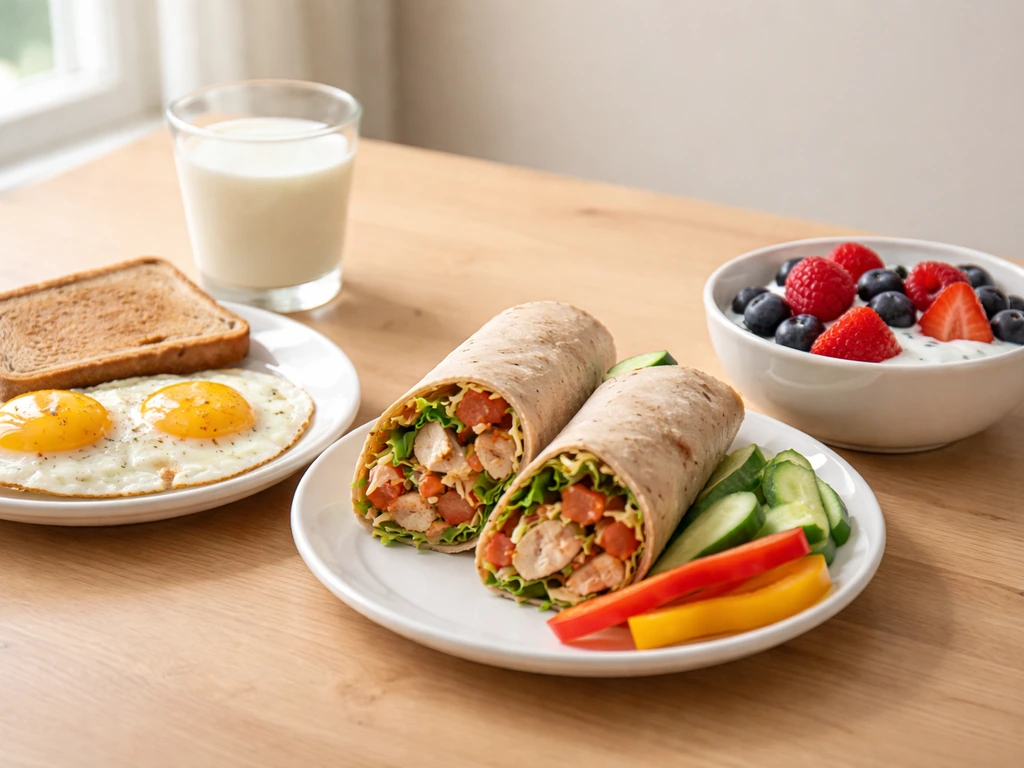
Hitting 70-80 grams of protein daily from food is more achievable than most people assume. A breakfast of two scrambled eggs with a cup of milk adds up to about 20 grams. A lunch with a chicken breast in a wrap adds another 30 grams. A dinner with lentil soup or a piece of fish gets you the rest. That's without any supplements.
Simple daily template for a growing teen (70-80g target)
| Meal | Food | Approx. Protein |
|---|---|---|
| Breakfast | 2 eggs + 1 cup milk + slice of whole grain toast | ~22 g |
| Lunch | Chicken breast wrap with veggies | ~33 g |
| Snack | Greek yogurt with berries | ~15 g |
| Dinner | Baked salmon + rice + vegetables | ~25 g |
| Total | ~95 g |
That template is roughly 95 grams, which comfortably covers even an active teen's needs. You don't need to be precise every day. Consistency over weeks matters more than hitting a perfect number daily.
The other factors that actually drive height growth
Protein is the most commonly asked-about nutrient for height, but it's rarely the limiting factor in well-nourished populations. The other inputs matter just as much, and sometimes more.
Genetics account for roughly 60-80% of your final height. This is the biggest factor by far. After that, total calorie intake matters because severe deficits redirect protein away from growth and into energy production. Calcium and vitamin D directly affect bone density and length. Sleep is the period when growth hormone is released most intensely, particularly in the first few hours of deep sleep, which is why skimping on sleep during adolescence is a legitimate concern for growth. Exercise, especially weight-bearing activity, stimulates bone remodeling and supports the hormonal environment for growth, though excessive endurance training in very young children may temporarily suppress growth hormones.
If you're curious about how calorie intake interacts with height growth specifically, that's its own nuanced topic. The relationship between protein intake and overall dietary adequacy is also worth understanding, because protein doesn't operate in isolation from total energy intake.
Realistic expectations and safety considerations
For kids and teens still growing
Meeting protein targets consistently during childhood and adolescence supports normal growth progression. If a child is protein-deficient, correcting that genuinely helps. But if they're already adequately nourished, optimizing protein further won't noticeably accelerate their height trajectory. The timeline here is years, not weeks. Growth is a slow process. A teen seeing a 6-8 cm growth spurt in a year is doing well, and nutrition supports that pace without rushing it.
For adults
Most people's growth plates close between ages 16 and 18 for females and 18 to 21 for males, though there's individual variation. Once plates close, no dietary intervention increases bone length. If you are wondering, can a fat person grow taller, the key point is that height depends on genetics, growth plates, and overall nutrition, not body fat alone. Protein at the EFSA PRI of 0.83 g/kg per day covers maintenance needs for adults, and higher intakes support muscle building and overall health. But the height ship has sailed. Adults searching for nutritional strategies to grow taller are better served understanding that the goal shifts from growth to maintaining good posture, bone density, and overall musculoskeletal health.
Is high protein intake safe?
EFSA notes there are blank" rel="noopener noreferrer">insufficient data to establish a formal tolerable upper intake level (UL) for protein, meaning we don't have a clear threshold at which protein becomes harmful for healthy people. That said, very high intakes (above 2.5 g/kg per day) for sustained periods have been associated with digestive discomfort, and extreme intakes put additional load on the kidneys, which is relevant for people with pre-existing kidney conditions. For healthy children and teens, staying in the 0.95 to 1.5 g/kg range depending on activity is safe and appropriate. Dietary Reference Intakes define blank" rel="noopener noreferrer">the UL as the maximum daily intake that is unlikely to cause adverse health effects. Protein supplements are rarely necessary for this age group if meals are reasonably balanced, and they shouldn't replace whole food sources that carry other growth-supporting nutrients.
The bottom line is practical: calculate your target using the body weight formula, build meals around whole protein sources, and make sure total calories, sleep, and calcium are also on track. That combination gives a growing body everything it needs. More protein beyond your target won't accelerate things, but consistently hitting it gives you the best chance of reaching your genetic potential.
FAQ
If I eat the right amount of protein, will I definitely grow taller faster?
Hitting your protein target supports normal growth, but it does not guarantee a faster growth rate. Growth speed depends heavily on sleep timing, total calories, vitamin D and calcium status, and genetics. If any of those are off, extra protein will not fully compensate.
Does protein need change during puberty, and should I adjust based on growth spurts?
Yes, protein needs scale with body weight and sometimes activity, so as a teen gains weight during a growth spurt, their grams per day estimate should usually rise too. A practical approach is to re-calculate every few months rather than chasing daily fluctuations in body weight.
How should I calculate protein if my scale is in pounds and I track only occasionally?
Convert once using kilograms = pounds ÷ 2.2, then multiply by your target (for example, 0.95 g/kg for many moderately active teens). It is fine to estimate using the most recent weight, because consistency over weeks matters more than perfect day-to-day precision.
Is protein from dairy or plant sources treated differently for height growth?
For growth, what matters most is meeting total protein and amino acid adequacy, not whether it is animal or plant-based. If you rely heavily on plants, vary sources (legumes, soy, grains, nuts, seeds) across the day to cover amino acids more reliably.
What if my calories are low, but I still hit my protein grams per day?
In a calorie deficit, protein can be used for energy rather than building new tissue, which can blunt growth-related processes. If your growth is a concern, the first step is usually correcting total intake and meal frequency, not further increasing protein.
Can too much protein slow growth or be harmful for teens?
For healthy teens, moderate excess is unlikely to stop height growth, but very high intakes (for example, sustained intakes above about 2.5 g/kg/day) may cause digestive issues and can increase kidney workload in people with existing kidney problems. If you are regularly above that range, review your overall diet and consider medical guidance.
Do I need to hit protein exactly every day, or is an average okay?
An average over time is what matters. If you are usually near target across several days, occasional misses are not a problem. Chasing exact numbers can create stress and crowd out other necessities like calcium, vitamin D, and enough calories.
Will protein powder help more than food for height?
Protein powder is mainly a tool to reach your total protein when whole foods are hard to manage. It does not add growth benefits by itself, and it should not replace foods that also bring calcium, vitamin D, iron, and overall energy.
If I am an adult with closed growth plates, can protein improve posture or bone health instead?
Yes, even though it cannot lengthen bones after growth plates close, adequate protein can support muscle strength and maintenance of musculoskeletal tissues, which can improve posture and overall functional health. For height-related goals in adults, focus on resistance training, calcium and vitamin D intake, and healthy sleep.
How do I know if I am protein-deficient versus just not seeing height gains?
Protein deficiency is more likely when overall intake is poor, weight gain is slow, or you consistently skip protein-containing meals. If you are already eating enough total calories and protein, lack of height gain is more often explained by genetics, sleep, micronutrients, and growth plate status than by protein adequacy.
Does exercise type matter for using nutrition to support growth?
Yes. Weight-bearing and resistance-type activities support bone remodeling and can complement proper nutrition. Very excessive endurance training in young children may be counterproductive, so balance matters along with protein and calories.
Next Article
How Much Calcium Per Day to Grow Taller: Targets by Age
Get age-based calcium targets, when it helps height growth, and how to meet needs with food, vitamin D, and testing.