
Viagra does not make you grow taller. It has no mechanism that activates bone lengthening, stimulates growth hormone, or reopens growth plates. Sildenafil (the active ingredient in Viagra) is a blood flow medication, not a growth drug, and there is no credible scientific evidence linking it to any increase in human stature at any age.
Does Viagra Make You Grow? Growth Plate and Height Facts

Marcus Reeves
1 Jun 2026
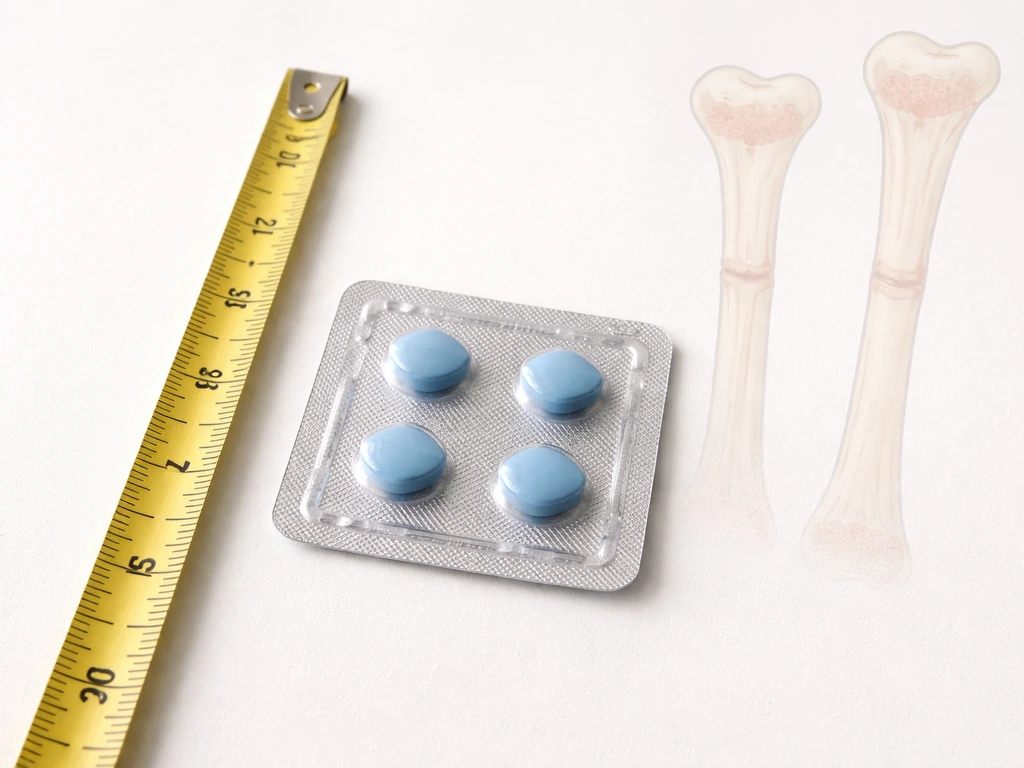
What Viagra actually does in your body

Viagra works by inhibiting an enzyme called phosphodiesterase type 5 (PDE5). In plain terms: your body produces a molecule called cyclic GMP (cGMP) in response to nitric oxide signaling, and cGMP causes smooth muscle in blood vessels to relax, which increases blood flow. PDE5 normally breaks cGMP down. Sildenafil blocks PDE5, so cGMP stays elevated longer and blood flow to specific tissues (notably in the penis, but also lungs) remains increased.
That is the entire mechanism. It is a vasodilator that works through the nitric oxide-cGMP pathway. It does not interact with growth hormone receptors, IGF-1 signaling, the hypothalamic-pituitary axis, or any of the endocrine machinery that governs skeletal growth. The FDA's prescribing information for Viagra is explicit: this drug is a selective PDE5 inhibitor, nothing more. VIAGRA is described in FDA labeling as a blank" rel="noopener noreferrer">selective inhibitor of cGMP-specific phosphodiesterase type 5 (PDE5). It was not designed to, and does not, add length to bones.
How height growth actually works (and why Viagra can't touch it)
Bones grow longer from specific cartilage zones called growth plates (also called epiphyseal plates), located near the ends of long bones like your femur and tibia. During childhood and adolescence, these plates are actively producing new cartilage cells that later calcify into bone, pushing the ends of your bones apart and making you taller. This process is driven by a hormonal cascade: growth hormone (GH) released by the pituitary gland stimulates the liver to produce IGF-1, which acts directly on growth plate cells to keep them dividing. Sex hormones like estrogen and testosterone also play a major role, especially during puberty.
Growth plate closure is what ends linear growth. As puberty progresses, rising levels of sex hormones eventually cause the growth plates to fuse, replacing the active cartilage with solid bone. An MRI study across 958 healthy subjects aged roughly 14 to 21 years found that closure is progressive and site-specific rather than a single event. The calcaneus (heel bone) tends to fuse first; the distal radius is among the last. Once any given plate has fused, that bone cannot grow longer, full stop. Research on pubertal growth confirms that growth velocity drops to zero after epiphyseal fusion. No drug, including Viagra, can reverse this process.
Interestingly, a 2024 paper in the Journal of Clinical Endocrinology and Metabolism noted that roughly 87% of final adult height is already achieved before the onset of puberty. That puts into perspective just how early most of the foundational growth happens and why interventions later in life rarely move the needle on final stature.
The Endocrine Society points out that clinicians evaluating growth concerns in young people often use bone age X-rays of the hand and wrist to assess growth plate maturity and estimate remaining growth potential. This is the kind of rigorous, evidence-based approach that matters when height is genuinely a concern. An ED medication has no place in that picture.
What the research says: Viagra and height

There are no peer-reviewed studies showing that sildenafil or any PDE5 inhibitor increases human height. None. The question itself does not appear in clinical trial registries as an active area of investigation, because there is no plausible mechanism to study. If you have seen claims online that Viagra adds inches to your height, those claims are not backed by any clinical or physiological evidence. Similarly, the idea behind “does salt in your shoes make you grow taller” is not supported by any credible evidence or plausible biology.
The research that does exist on sildenafil's effects on body composition points in a completely different direction. One randomized, double-blind, placebo-controlled study found that low-dose sildenafil (25 mg daily for 15 days) increased muscle protein synthesis and altered muscle-related molecular markers in men. This is genuinely interesting science about how PDE5 inhibition might affect skeletal muscle physiology. But increased muscle protein synthesis is not the same as growing taller. It describes changes at the cellular level in muscle tissue, not the addition of bone length.
To be direct about the "how much does Viagra make you grow" version of this question: asking "how much" presupposes an effect that does not exist. There is no measurable amount of height gain attributable to sildenafil because the mechanism does not produce any.
Body changes that might be mistaken for "growth"
There are a few ways someone might perceive physical changes on Viagra that are not actual height increases but could be interpreted that way if you are not thinking carefully about the mechanism.
- Improved posture: Better blood flow and reduced fatigue (or psychological confidence from improved erectile function) can lead someone to stand straighter. Standing straight can add a visible 1 to 2 centimeters in measured height compared to slouching, but your skeleton has not changed.
- Muscle changes: The muscle protein synthesis finding mentioned above means your muscle tissue may respond slightly differently on sildenafil. Marginally more muscle fullness can change how you look and feel physically, but muscles do not make bones longer.
- Reduced muscle fatigue: The same study noted reduced muscle fatigue, which could make physical activity feel easier and potentially support better training, but any downstream effect on body composition is not linear height growth.
- Genital engorgement: Sildenafil increases blood flow to the genitals, which some people casually describe as "growth." This is a temporary vascular effect, not tissue proliferation, and is irrelevant to stature.
- Water retention or weight shifts: Vasodilatory drugs can cause minor temporary fluid distribution changes. This is not skeletal growth.
None of these effects are permanent structural changes to bone. Once the drug clears your system, vascular effects resolve. The only physical changes worth discussing seriously are whether sildenafil's muscle physiology effects could support better athletic performance over time, but even that is a long way from adding height.
Safety, risks, and who should not use Viagra

Viagra is a prescription medication for a reason. Using it without medical supervision for a purpose it was not designed for (including a hoped-for height effect that does not exist) is both medically inappropriate and potentially dangerous.
The most serious risk is a dangerous drop in blood pressure. Sildenafil is absolutely contraindicated with nitrates (drugs prescribed for chest pain like nitroglycerin) and with riociguat (used for pulmonary arterial hypertension). Combining sildenafil with these medications can cause a sudden and severe drop in blood pressure that can be life-threatening. "Poppers" (amyl nitrite or nitrite-based recreational drugs) fall into the same category. Mayo Clinic's guidance is explicit on this. These are not minor cautions; they are hard stops.
Beyond the contraindications, common side effects of sildenafil include headache, flushing, nasal congestion, visual disturbances (including changes in color perception), and dizziness from blood pressure changes. In younger, otherwise healthy people experimenting with the drug out of curiosity, these effects are unpredictable without a medical history review.
If you are an adolescent or young adult still potentially in a growth phase, the answer is even clearer: Viagra is not approved for use in children or adolescents for height-related purposes, and there is no evidence it would help. Mayo Clinic also notes that blank" rel="noopener noreferrer">by about age 12 most girls’ growth plates have already matured and been replaced with solid bone. Birth control works differently from sildenafil, and it is not known to lengthen bones or increase final height once growth plates close can birth control make you grow taller. If you have genuine concerns about your height trajectory, the right step is a pediatric endocrinologist or your family physician, not a prescription drug obtained for off-label self-experimentation.
| Risk / Contraindication | Details |
|---|---|
| Nitrate medications | Absolute contraindication; combined use can cause life-threatening hypotension |
| Riociguat (Adempas) | Absolute contraindication per FDA labeling and Mayo Clinic guidance |
| Recreational nitrites ("poppers") | Same dangerous hypotension risk as prescription nitrates |
| Cardiovascular disease | Should only use under physician supervision; blood pressure changes are significant |
| Hypotension | Pre-existing low blood pressure greatly increases risk of adverse events |
| Under 18 (for ED indication) | Not approved; safety profile in adolescents is not established for this use |
| Vision or hearing issues | Rare but serious events (non-arteritic ischemic optic neuropathy, sudden hearing loss) reported |
What actually works for maximizing height potential
If you are still growing (typically under age 18 to 20, though the exact window depends on your individual growth plate status), there are evidence-based factors that genuinely influence how much of your genetic height potential you reach. None of them involve ED medications.
- Nutrition: Adequate protein, calcium, vitamin D, and zinc are essential for bone development during growth phases. Chronic undernutrition is one of the most well-documented causes of stunted growth worldwide. Getting enough calories and micronutrients is foundational.
- Sleep: Growth hormone is primarily secreted during deep sleep, especially in the first few hours after falling asleep. Consistently getting 8 to 10 hours of quality sleep as an adolescent directly supports the hormonal environment needed for growth.
- Physical activity: Weight-bearing exercise and resistance training stimulate bone remodeling and support healthy GH and IGF-1 levels. High-impact activities during the growing years are associated with better bone density and proper skeletal development.
- Avoiding growth suppressors: Smoking, chronic alcohol use, and unmanaged stress can impair GH secretion and disrupt the endocrine environment that supports growth. Anabolic steroids used during adolescence can paradoxically shorten final height by accelerating growth plate closure.
- Medical evaluation for underlying conditions: Thyroid disorders, growth hormone deficiency, celiac disease, and other medical conditions can all impair growth. If a child or teenager is significantly shorter than expected, a physician can assess bone age and hormonal status to determine if there is a treatable cause.
- Genetics: About 60 to 80% of height variation is genetic. Understanding your family's height pattern gives a realistic baseline for what to expect, and a doctor can calculate a midparental height estimate to guide expectations.
If your growth plates are already closed (which is likely if you are over 20, and possible even in your mid-to-late teens depending on sex and individual timing), no intervention will add skeletal height. The focus at that point shifts to posture, core strength, and overall health rather than any attempt to reopen or stimulate closed plates. This applies to Viagra, but also to other things people wonder about for height, like steroids or various supplements. Steroid use cannot reopen closed growth plates or override the biology that limits linear bone growth steroids. The biology is the same: closed plates mean the window is shut.
When to talk to a doctor
If you are a parent concerned about a child's growth, or if you are a teenager who feels your growth has stalled unexpectedly, an endocrinologist is the right first call. A bone age X-ray can tell you where you actually are in the process. If genuine growth hormone deficiency is identified, there are approved, medically supervised treatments (recombinant GH therapy) that can help, but these are prescribed and monitored carefully, not improvised.
If you are an adult who has come across claims that Viagra or any similar drug adds height and you are tempted to try it, please talk to a physician first. Not because Viagra is going to help your height (it will not), but because understanding your cardiovascular health and current medications matters before taking any vasodilatory drug. Self-medicating with a prescription medication based on internet claims is a way to expose yourself to real side effects in exchange for an outcome that is physiologically impossible.
FAQ
Can Viagra increase height indirectly by improving circulation or workout performance?
Viagra can increase blood flow and may alter muscle-related markers in the short term, but that does not create new bone. Any workout benefits would not translate into lengthening growth plates or changing final skeletal height, and effects that seem like “growth” usually come from posture, swelling, or temporary pump rather than new bone.
What if I feel taller after taking Viagra, does that mean it is working?
Feeling taller is not the same as gaining height. Common possibilities are transient changes in vascular tone, temporary fluid shifts, reduced muscle tightness, or improved confidence and posture while you are under the drug’s effects. Real height change requires structural bone change, which sildenafil cannot produce.
Does Viagra help if my growth plates are not fully closed yet?
Even during the teen years when growth plates are still active, sildenafil does not target the growth plate signaling pathways. Clinicians would assess growth potential with bone age, growth velocity, and hormone evaluation, not an ED medication, and bone age results guide whether any treatment could help.
Are there any “dose” tricks that make Viagra grow you taller?
No. Increasing dose does not create a mechanism for bone lengthening, it only increases the likelihood of side effects and dangerous blood pressure drops. Using higher doses or more frequent dosing without medical supervision raises risk without any realistic path to height gain.
Is Viagra safe to try for height if I do not have heart problems or I am not on other meds?
Lack of known heart disease does not eliminate risk. Sildenafil can still cause dizziness and significant blood pressure changes, and you may not know you have contraindicated conditions or interactions. A clinician should review your medication list and medical history before any vasodilatory PDE5 inhibitor is taken.
What are the biggest interaction risks if someone takes Viagra believing it affects height?
The most dangerous issue is combining sildenafil with nitrates (for chest pain) or riociguat, because it can cause a sudden severe drop in blood pressure. “Poppers” (nitrite-based recreational drugs) are also in the same danger zone, so combining them with sildenafil can be life-threatening.
Could Viagra be making me taller because of better erections and better posture?
Improved sexual function does not affect growth plate activity. If posture changes make you stand taller, that can affect measured height temporarily, but it is not structural growth and it goes away when the effect on the body wears off.
If I am concerned about delayed growth, what should I do instead of taking Viagra?
Start with a pediatrician or pediatric endocrinologist. They may order a bone age X-ray (often hand and wrist), check growth velocity over time, and evaluate for hormone or nutritional causes. If a true deficiency is found, treatments like medically supervised growth hormone are prescription-based and monitored.
I am over 20, can Viagra still increase my height at all?
Once growth plates have fused, no medication can reopen them. At that point, there is no evidence sildenafil can add skeletal height, and efforts should shift to practical factors like posture, strength, and overall health rather than prescription experimentation.
Why do online claims about Viagra and height keep spreading?
Claims often mix unrelated effects (temporary pump, posture changes, or general improvements in gym performance) with misleading before-and-after measurements. Without proof of new bone formation or changes on imaging, those anecdotes cannot establish height gain from the drug.
Next Article
Do Steroids Make You Grow Taller? What the Evidence Shows
Steroids do not help adults grow taller; only certain childhood cases may increase height by treating causes.