
No, you do not grow taller specifically on your birthday. There is no biological mechanism that triggers bone growth on a particular calendar date. Any height difference you notice around your birthday is almost certainly explained by normal daily height variation, measurement inconsistency, or the slow, ongoing growth that was already happening before and after that date. Birthdays feel significant, but your skeleton does not keep track of them.
Do You Grow Taller on Your Birthday? Science and Guidance

Marcus Reeves
17 May 2026

Why height can look different from one day to the next

Here is something most people do not realize: you are actually tallest first thing in the morning and shorter by evening. The difference can be as much as 18 mm (nearly three quarters of an inch) in a single day. This is not a myth or an illusion. It is a well-documented physiological effect called diurnal height variation, and it happens because of your intervertebral discs.
While you sleep lying down, the compressive load on your spine is essentially zero. Your intervertebral discs rehydrate overnight by absorbing fluid back in, a process called imbibition. The moment you stand up and start moving, gravity and the weight of your upper body begin compressing those discs again, slowly squeezing fluid out. By the end of a normal day of sitting, standing, and walking, your spine has compressed enough to measurably reduce your standing height. Then you sleep again, and the cycle resets.
This matters because a lot of people measure themselves at different times of day on different occasions. If you happened to measure yourself in the morning on your last birthday and in the evening this year, the difference you see is almost certainly disc-related variation, not new bone growth. This is also why clinicians assess growth velocity over months, not days, and never rely on a single snapshot measurement to determine whether a child or teenager is actually growing.
Age matters: growth plates, puberty, and how much you can actually grow
Whether any real height growth is even possible for you right now depends almost entirely on your age and skeletal maturity, not on any specific date. Growth happens when the cartilaginous growth plates (also called physes) at the ends of your long bones are still open and actively producing new bone tissue. This process is driven by the interaction between sex hormones and the growth hormone/IGF-1 axis, and it follows a predictable but individually timed sequence across life.
In infancy, growth is rapid. Through childhood, it slows to a steadier pace. Then puberty triggers the final growth spurt, where sex steroids amplify growth hormone secretion and temporarily accelerate bone elongation. So, while stretching can help flexibility and posture, it does not directly change how much you grow during puberty puberty triggers the final growth spurt. After puberty winds down, the growth plates gradually fuse, and skeletal height is essentially locked in. For most girls, plates close sometime in the mid to late teens. For most boys, it tends to happen a bit later, often by the late teens to early twenties, though individual variation is real.
If a doctor needs to know how much growth potential remains, they use a bone age assessment, typically a left hand and wrist X-ray compared against a standard atlas of skeletal maturity. Open growth plates mean height potential remains. Fused plates mean no further skeletal lengthening is biologically possible, birthday or not.
| Life Stage | Growth Plates Status | Real Height Growth Possible? |
|---|---|---|
| Early childhood (under ~10) | Fully open | Yes, ongoing steadily |
| Puberty / adolescence | Open, actively lengthening | Yes, often fastest growth here |
| Late teens (post-puberty) | Closing or recently fused | Minimal to none |
| Adulthood (plates fused) | Fully closed | No new skeletal growth |
What actually supports growth (and what does not)

For children and teenagers with open growth plates, several modifiable factors genuinely influence how well the body can achieve its genetic height potential. None of them are birthday-specific, and none of them work overnight. But they do matter consistently over weeks and months.
Sleep
Growth hormone is secreted in pulses, and the largest pulse occurs during deep sleep. Children aged 1 to 2 need around 11 to 14 hours per night; school-age kids and teens need 8 to 10 hours. Chronically short sleep does not just make you tired, it can blunt the hormonal signals that support growth. Consistent, adequate sleep is probably the single most underrated growth-support tool available.
Nutrition

Bone growth requires raw materials. Calcium needs vary by age: children aged 4 to 8 need around 1,000 mg per day, and adolescents aged 9 to 18 need approximately 1,300 mg per day. Vitamin D is needed to absorb that calcium properly, and many kids fall short, especially in northern latitudes or with limited sun exposure. Protein matters too, because low protein intake suppresses IGF-1, one of the key growth signals in the body. A diet with adequate calories, calcium-rich foods, vitamin D (from food or supplementation if deficient), and quality protein gives the body what it needs to grow as effectively as genetics allow.
Physical activity and exercise
Regular physical activity supports bone density and general health during growth. Weight-bearing exercise in particular stimulates bone remodeling. There is no evidence that any specific exercise directly adds centimeters to your height, but staying active as a child or teen keeps the whole growth system functioning well. For adults with closed growth plates, exercise focused on posture and core strength can improve how tall you appear and how you carry yourself, even if it cannot add skeletal height.
Overall health
Chronic illness, untreated hormonal conditions, and severe nutritional deficiencies can all suppress growth in children. Treating underlying medical conditions promptly is one of the most impactful things a parent or child can do to protect height potential. This is why pediatric growth monitoring exists: not to celebrate birthday-to-birthday comparisons, but to detect trends early.
Birthday growth myths and "hacks" worth ignoring
The internet has no shortage of claims that some supplement, patch, stretching routine, or special food can trigger inches of height gain in a matter of weeks. None of these hold up. Height-increasing patches have been fact-checked and debunked repeatedly. There is no topical product or short-term supplement regimen that can reopen fused growth plates or accelerate bone elongation in someone who has finished puberty.
Stretching and hanging from a bar do temporarily decompress the spine, which is why some people report feeling a little taller after doing them. If you are hoping stretching before bed will help you grow, the key takeaway is that any temporary “decompression” effect is not the same as new bone growth. That is the same disc rehydration effect described earlier. It is real in the moment but not a lasting height increase. For more on whether hanging or stretching provides genuine lasting growth benefits, those questions are worth exploring separately since the science there is nuanced depending on your age and growth stage. For a fuller look at that topic, see does hanging help you grow. Some people also ask whether hanging upside down helps you grow taller, but the key question is whether it can produce lasting changes to height or only temporary effects.
The idea of a "birthday growth" is in the same category: appealing, harmless as a belief, but not supported by any endocrine or orthopedic mechanism. Growth happens continuously during childhood and puberty, not in annual bursts timed to a date. If you seem taller on your birthday than last year, that is because slow, steady growth accumulated over 12 months, not because the day itself did anything.
How to measure your height correctly and actually track changes
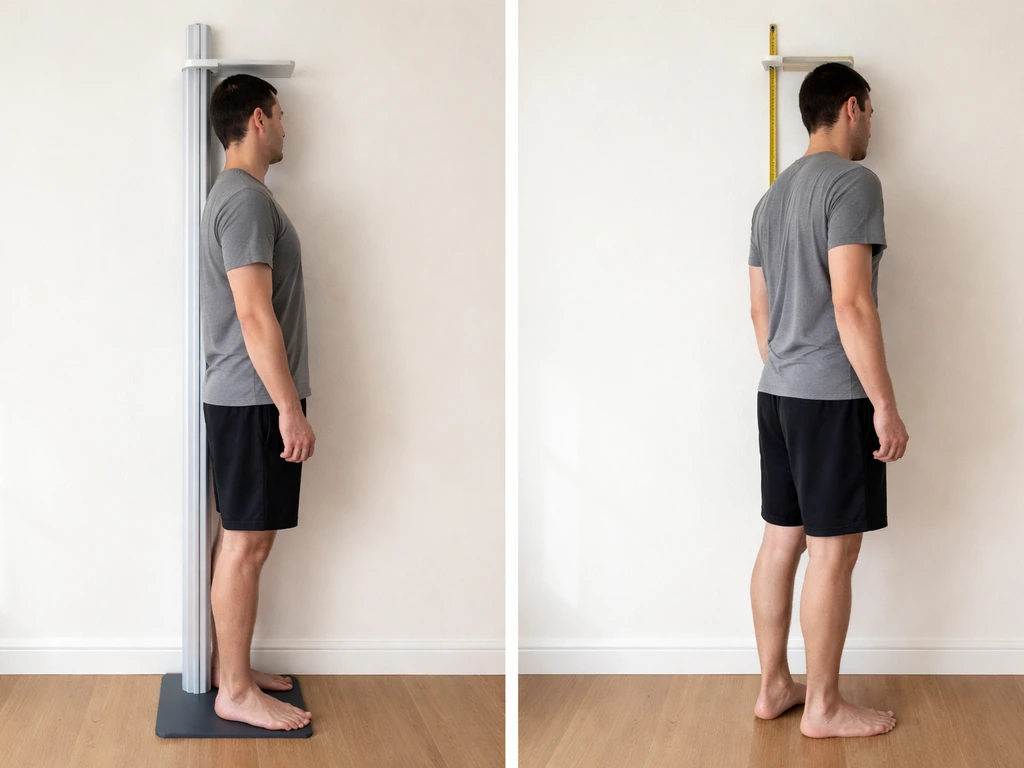
If you want to know whether you or your child is genuinely growing, measurement consistency is everything. A single height reading tells you almost nothing about growth rate. What matters is comparing measurements taken the same way, at the same time of day, ideally months apart.
- Use a stadiometer or a fixed measuring tape mounted flush against a flat wall with no baseboard interference.
- Measure in the morning, before significant activity, and always at the same time of day.
- Stand with heels together touching the wall, back as straight as comfortable, and eyes looking straight ahead (this is called the Frankfort plane position). No shoes.
- Have someone else read the measurement at eye level with the headboard or marker to avoid parallax error.
- Record the measurement and date, then repeat in 3 to 6 months minimum. Shorter intervals produce unreliable results.
- For meaningful growth velocity, a 6 to 12 month window is optimal, which is exactly what pediatric clinicians use.
Measuring birthday to birthday is actually a decent interval length (12 months), as long as the measurement method is consistent both times. The problem is most people do not control for time of day, posture, or whether they were wearing socks last year. Standardize everything, and the numbers become genuinely informative.
When to talk to a doctor about height and growth
Most children grow at their own pace within a normal range, and a lot of variation is just genetics. But there are specific situations where a doctor visit is genuinely warranted, not just reassuring.
- A child's growth velocity has slowed noticeably compared to prior years and is not explained by the natural tapering that happens after puberty.
- A child or teen is significantly shorter than peers of the same age and sex with no obvious family pattern to explain it.
- Puberty has not started by age 13 in girls or 14 in boys, which can affect timing and intensity of the growth spurt.
- You are concerned about height but have no idea whether growth plates are still open (a bone age X-ray can answer this quickly).
- There are other symptoms alongside poor growth: fatigue, delayed development, frequent illness, or unexplained weight changes.
A pediatric endocrinologist can assess growth velocity over time, check bone age, run hormone panels if needed, and determine whether any intervention is appropriate. The Endocrine Society is clear that slowing growth rate in adolescence can be a signal of delayed puberty or other underlying issues, and catching those early makes a real difference. Waiting and hoping is not a strategy.
For adults whose growth plates are closed, the realistic path to looking taller involves posture correction, core and back strengthening, and in some cases targeted postural exercise programs. These do not add skeletal height, but they can meaningfully change how tall you appear and how you feel in your body. Surgical stature lengthening exists but is a significant procedure reserved for specific medical situations, not a general option for healthy adults who simply want to be taller.
The bottom line: your birthday is a fine time to measure your height as part of a yearly check-in, but the day itself does not cause growth. Growth is a slow, hormonally driven, nutrition-dependent process that happens across months and years. If you are in a growth stage of life, support it consistently with sleep, good nutrition, and staying healthy. If your plates are closed, focus on what you can actually influence: posture, strength, and a realistic understanding of your body. If you are asking will you grow taller if you jump every day, the key question is whether your growth plates are still open If your plates are closed.
FAQ
How can I tell if my height change around my birthday is real or just normal daily variation?
If you want to check whether you are truly gaining height, measure at the same time of day (ideally first thing after waking), use the same method (no shoes, same wall/step height setup), and record over multiple months. A change of a few millimeters can be explained by diurnal disc compression, but a sustained shift across several consistent readings is more likely to reflect real growth.
Is it accurate to compare height from one birthday to the next?
Yes, a “birthday-to-birthday” comparison can show true growth, but only if you control the big confounders. If one birthday measurement happened in the afternoon and the other in the morning, you can easily be off by up to about 18 mm due to disc-related height variation, even with no skeletal growth.
At what point should I worry if my child does not grow between birthdays?
For kids and teens, doctors typically look at growth rate over time (for example, measurements across 6 to 12 months) rather than focusing on a single day or event. If you are seeing no change at all for a year, or growth has dropped off compared with prior trends, that is the kind of pattern a clinician would evaluate.
If I am an adult, can I still grow taller with stretching or hanging?
If growth plates have fused, you cannot increase skeletal height through stretching, hanging, or supplements. In that case, any “taller” effect is posture and spinal decompression only, and exercises that target core and upper back control are the most realistic way to improve how tall you appear.
Does being in puberty change how I should think about height changes around my birthday?
Birthdays do not matter biologically, but your growth stage does. If you are prepubertal or in early puberty, you still have remaining growth potential if growth plates are open, and improvements in sleep, nutrition, and health can support reaching your genetic maximum.
Why do I seem shorter later in the day even if I have not changed anything else?
If you are routinely seeing a lower number later in the day, that is expected, and it does not mean you “lost height” permanently. Try using your morning measurement as your main reference point and include footwear and posture notes only when needed, not for trend tracking.
When would a bone age assessment be useful, and what does it actually answer?
Bone age can clarify whether there is remaining height potential, especially when growth rate seems slower than expected. Clinicians often interpret bone age alongside growth velocity and sometimes labs, because bone age alone does not tell you how fast growth is happening right now.
What lifestyle factor is most likely to matter if my child’s growth seems slow?
If a child has persistently poor sleep, inadequate calories, or a limited diet, it can blunt the hormonal signals that support growth, including IGF-1 dynamics. The key is consistency, because one improved night or one calcium-rich day is not enough to change the growth trajectory.
Are supplements worth it for increasing height?
Some people use supplements to try to force height gains, but short-term “height” claims generally do not hold up. The only nutrition supplements that are truly useful are the ones correcting an identified deficiency, such as vitamin D or insufficient protein, ideally discussed with a clinician.
Can stretching or hanging lead to lasting height increases, or is it only temporary?
Stretching and hanging can temporarily change how tall you measure by decompressing the spine and changing disc fluid distribution. If your goal is lasting height-related improvement, think in terms of posture and strength training, because temporary decompression does not reopen fused growth plates.
What signs suggest we should book a checkup with a pediatric endocrinologist for growth concerns?
You should consider a clinician evaluation if growth seems to be slowing compared with your child’s usual pattern, if puberty appears unusually early or late, or if there are symptoms suggesting an endocrine or nutritional issue. The most important decision aid is the trend in growth velocity over months, not a single measurement.
If my growth plates are still open, what should I focus on month-to-month instead of day-to-day height changes?
If your plates are open, height outcomes depend on time plus biology, but you can still improve the odds by prioritizing adequate sleep hours for your age, enough total calories, enough calcium and protein, and consistent healthy activity. The practical takeaway is to keep the basics steady for weeks to months rather than waiting for a specific date effect.
Citations
There is no medically supported mechanism for humans to increase skeletal height on a specific calendar day (e.g., their birthday). Height change on a single day would be explained by factors like measurement/posture and diurnal (within-day) height variation rather than true bone elongation.
https://www.ncbi.nlm.nih.gov/sites/books/NBK279142/
Endocrinology references emphasize assessing growth using growth *velocity* across months (not single days) and note that only longer-interval measurements produce reliable growth-rate calculations.
https://www.ncbi.nlm.nih.gov/sites/books/NBK279142/
Minimum time interval for a reliable growth velocity calculation is ~3 months; a longer interval (6–12 months) is optimal.
https://www.ncbi.nlm.nih.gov/sites/books/NBK279142/
Clinical guidance for growth monitoring uses repeat measurements over months/years (e.g., growth velocity in cm/year derived from height over a 6-month-ish interval or longer), not day-to-day or birthday-to-birthday intervals.
https://eqipp.aap.org/courses/growth2/mn/clinical-guide/popups/growth-velocity
Diurnal variation exists: total body height is typically higher in the morning and lower later in the day due to spinal compression/decompression effects.
https://journals.sagepub.com/doi/10.1243/EMED_JOUR_1983_012_026_02
Study evidence describes an overall reduction in spine/standing height during the day attributable to disc fluid expression from upright loading, and recovery during rest/recumbency.
https://www.sciencedirect.com/science/article/pii/S000368700800032X
One classic report found that standing height after waking can be up to ~18 mm greater than later in the day under a defined “as tall as possible” measurement protocol (showing magnitude can be measurable).
https://journals.sagepub.com/doi/10.1243/EMED_JOUR_1983_012_026_02
Another physiology/biomechanics line of evidence explains the mechanism: compressive loading during the day reduces intervertebral disc height via fluid expression, while low loading/rest restores disc height by fluid imbibition.
https://www.tandfonline.com/doi/abs/10.1080/10255840903337855
Pubertal growth (growth spurt) is driven by interactions between sex steroids and the GH–IGF-1 axis; sex steroids modulate growth hormone secretion and thereby affect the timing/intensity of the pubertal growth spurt.
https://pubmed.ncbi.nlm.nih.gov/2029886/
Endocrinology references describe the pattern of growth as changing across life stages (infancy → childhood → puberty as a final phase) rather than as abrupt single-day changes.
https://www.ncbi.nlm.nih.gov/books/NBK278971/
Height growth is assessed clinically as velocity over time; Endotext notes that puberty and pubertal staging must be considered when interpreting growth velocity because onset/rate vary substantially by individual.
https://www.ncbi.nlm.nih.gov/sites/books/NBK279142/
Risk of “missing” true growth changes is minimized by using multiple visits and longer intervals; single height measurements are not adequate to determine growth rate.
https://www.ncbi.nlm.nih.gov/sites/books/NBK279142/
Bone age/bone maturity (often via a left hand and wrist X-ray compared to an atlas) is used clinically to estimate skeletal maturity and thus remaining growth potential (open vs nearly fused growth plates).
https://www.wikipedia.org/
Bone age assessment is used to estimate whether growth plates are still active; this determines whether a child has remaining height potential vs near final stature.
https://agefinder.org/bone-age/bone-age-height-prediction/
Endocrine/clinical guidance emphasizes that growth monitoring should account for pubertal status and that a slowing growth rate in adolescence may indicate delayed puberty or lack of puberty—indicating that growth continuation is tied to maturation stage, not a specific calendar date.
https://www.endocrine.org/patient-engagement/endocrine-library/growth-and-short-stature
Puberty staging affects growth continuation, and growth spurt timing/intensity differs between boys and girls; this is why clinicians track growth velocity alongside pubertal development.
https://www.ncbi.nlm.nih.gov/books/NBK534827/
For sleep as a modifiable factor: NHLBI/NIH notes recommended sleep durations for children (e.g., 1–2 years: 11–14 hours) as part of general health; insufficient sleep is associated with worse health outcomes and is commonly treated as relevant to growth/repair processes.
https://www.nhlbi.nih.gov/health/sleep/how-much-sleep
AAP Pediatrics article on bone health notes modifiable determinants include nutritional intake of calcium, vitamin D, protein, and healthy body weight/hormonal status; it also endorses Institute of Medicine–based calcium/vitamin D recommendations.
https://publications.aap.org/pediatrics/article/134/4/e1229/32964/Optimizing-Bone-Health-in-Children-and-Adolescents
AAP article provides vitamin D supplementation approach examples (e.g., regimens used to achieve serum 25-OH-D above 20 ng/mL and maintenance dosing), reflecting how deficiency is treated to support bone health during growth.
https://publications.aap.org/pediatrics/article/134/4/e1229/32964/Optimizing-Bone-Health-in-Children-and-Adolescents
NIH Office of Dietary Supplements lists calcium intake recommendations that vary by age for infants/children/adolescents (ranging from ~200 mg in early infancy to ~1,300 mg in children/adolescents depending on age).
https://ods.od.nih.gov/factsheets/calcium-HealthProfessional/
NIAMS notes calcium/vitamin D are important for bone health, and provides age-grouped calcium needs (e.g., children 4–8 years: 1,000 mg/day).
https://www.niams.nih.gov/health-topics/calcium-and-vitamin-d-important-bone-health
Protein and other nutrients influence growth/IGF-1-related pathways; an international osteoporosis organization review notes low protein intake can be detrimental for skeletal integrity (via reduced production/action of IGF-1).
https://www.osteoporosis.foundation/health-professionals/prevention/nutrition-children-and-adolescents
After growth plates are closed, true skeletal lengthening is generally not possible; cosmetic “stature lengthening” procedures require evidence of closed/open growth plates depending on age/eligibility, and the provider must confirm skeletal maturity on X-rays.
https://www.hss.edu/health-library/conditions-and-treatments/frequently-asked-questions-about-stature-lengthening-surgery
Leg lengthening/limb lengthening procedures involve cutting at the end of the bone near the growth plate area (and subsequent distraction healing); it is a surgical method and not something achievable through normal exercise or dieting.
https://medlineplus.gov/ency/article/002965.htm
Clinical posture/post-exercise may produce immediate changes in measured stature, especially in older adults, but this reflects measurement/posture rather than new bone growth.
https://pmc.ncbi.nlm.nih.gov/articles/PMC10974903/
There is limited evidence that stretching/inversion provides lasting skeletal height gains; any observed increase is usually temporary and consistent with reduced spinal compression rather than reopened growth plates.
https://www.healthline.com/nutrition/increasing-height
Common “birthday hack” claims (e.g., special patches/shoes) are repeatedly debunked by fact-checkers as unsupported by credible medical evidence, with the underlying issue that adults cannot add skeletal height without appropriate medical/surgical indications.
https://www.politifact.com/factchecks/2022/apr/28/facebook-posts/no-these-patches-wont-make-you-grow-inches-weeks/
Medical sources stress accuracy: the CDC/anthropometry manuals use a stadiometer and strict standing position conventions (e.g., heels together, head in Frankfort plane) to reduce measurement error.
https://stacks.cdc.gov/view/cdc/181481/cdc_181481_DS1.pdf
CDC NHANES anthropometry procedures describe stadiometer-based measurement and explicitly discuss head positioning/standing posture and avoiding footwear/shoe effects for height measurement.
https://wwwn.cdc.gov/nchs/data/nhanes/public/2021/manuals/2021-Anthropometry-Procedures-Manual-508.pdf
StatPearls’ clinical height assessment overview notes stadiometer use is preferred and includes evidence that measured height can decrease by a clinically meaningful amount across the day depending on when it is taken.
https://www.ncbi.nlm.nih.gov/sites/books/NBK551524/
A PubMed article (University of Wisconsin) highlights that clinical height measurements can be unreliable due to technique/equipment factors—supporting the need for standardized measurement methods and repeated standardized checks.
https://pubmed.ncbi.nlm.nih.gov/27207559/
Endocrine Society guidance: slowing height growth rate in adolescence may indicate delayed puberty or lack of puberty; this is a key “reason to evaluate,” not waiting for a single-day change.
https://www.endocrine.org/patient-engagement/endocrine-library/growth-and-short-stature
Next Article
Does Stretching Before Bed Help You Grow Taller?
Does stretching before bed help you grow? Real growth plates matter; stretching may improve posture and sleep, not heigh